
MindShin
Focus, patience, and the calm attention that traditional practice builds over years.
San Francisco · Since 2005
Traditional Okinawan Shorin Ryu and Shudokan karate for adults — taught with care in a small, welcoming dojo in the Mission. Fun, friendly classes. Try one free.
Philosophy · 道
The club's intent is to develop the whole person. Traditional karate becomes a medium for understanding, where students grow physically and mentally through patient training and conditioning.
Focus, patience, and the calm attention that traditional practice builds over years.
Conditioning, stance, and clean technique through basics, kata, and partner work.
The energy and resolve to keep showing up, on the floor and in everyday life.
Training
At OKC San Francisco the training is traditional and practical: basic drills, physical conditioning, two-person and self-defense techniques, sparring, kata and its application.


Your first class
You do not need experience, equipment, or a uniform to begin. Just come as you are and step on the floor — the first class is on us.
Send a quick message, call, or fill out the form. Tell us a little about yourself — no experience required.
Saturday is usually the best class for a first visit, and Tuesday visitors are welcome too. Arrive a few minutes early to meet the group. Wear loose, comfortable clothes — no uniform or gear needed to begin.
Step on the floor, try a real class, and decide afterward. No contracts, no pressure.
Schedule & Location
New students are welcome at either weekly class, but Saturday is usually the best first visit. Occasional Sunday open training happens by announcement only, so please email before coming for that.
Group class New students welcome
Group class Best for first visits
Open training By announcement only
Before you come Email to confirm the date
2095 Harrison Street, at 17th & Harrison
San Francisco, CA 94110
Before you come
New to the dojo? Here is what most first-timers want to know before stepping on the floor.
Completely. Most students start with no experience, and every drill is scaled to your level. Your first class is free, so you can try it with no commitment.
Loose, comfortable clothing and some water. You don't need a uniform or any gear to begin — we train barefoot on the mats.
A class blends warm-up and conditioning, traditional basics and kata, and partner work — always at a pace that fits the people on the floor that day.
You won't be alone. At least a couple of us also have old injuries we're working around. Let an instructor know before class and they'll adapt the techniques for you. You train at your own pace; there's no pressure to keep up.
We're co-located with Project Commotion at 2095 Harrison Street, at 17th and Harrison in the Mission — a ten-minute walk from 16th Street Mission BART, with free street parking nearby.
$80 a month with no contracts, and your first class is free. Saturday is usually the best class for a first visit, but Tuesday works too if that fits your schedule.
Yes. The dojo is a ten-minute walk from 16th Street Mission BART, so students train with us from across the San Francisco Bay Area, including the East Bay and the Peninsula. If you drive, free street parking is easy to find nearby.
Not at the moment — our classes are for adults, 18 and up. If you're looking for children's karate in San Francisco, other dojos around the city offer good kids' programs, and we're happy to point you in the right direction if you reach out. And if you're a parent who wants to train yourself, you're in exactly the right place.
Karate is a great fit if you want a traditional striking art that builds technique, conditioning, and calm focus over time. Where grappling arts like Brazilian jiu-jitsu or judo center on throws and ground work, our training centers on strikes, blocks, stances, kata, and practical self-defense, with controlled sparring rather than full-contact competition. If you want a friendly, non-competitive place to start martial arts as an adult, karate is a very good way in.
Instructors
OKC San Francisco is led by instructors with decades of martial arts, self-defense, teaching, and community experience.
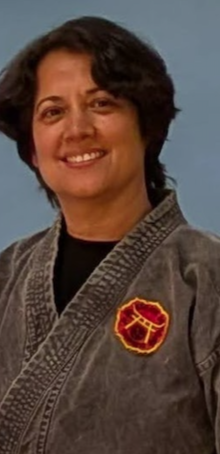
The head instructor for OKC San Francisco, established in 2005, is Michele Elefante Sensei. She holds the rank of Kyoshi, 7th Dan, in Shobayashi Shorin-Ryu and Shudokan Karate. She began her formal study of martial arts in 1990. She joined OKC Dallas in 1999 under Ilene Smoger Sensei, 9th Dan, Hanshi in Shorin Ryu, who is currently the Director of Training at OKCD. She was honored to receive her Shodan rank directly from Shimabukuro O'Sensei several years later.
With the encouragement and support of Smoger Sensei she began OKC San Francisco and later OKC UC Davis. She has instructed numerous times at National Women's Martial Arts Federation Special Training, Pacific Association of Women Martial Artists training, and Association of Women Martial Artists conferences. She has also hosted and instructed at OKC national seminars. She continues to teach self-defense workshops throughout the United States and is a licensed Marriage and Family Therapist in California.
She currently resides in Washington and supports the OKC San Francisco dojo remotely, teaching weekly virtual classes.
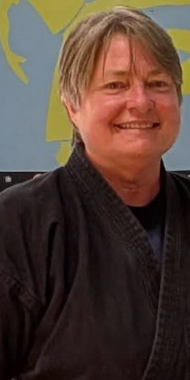
Deb Lee Sensei is an instructor at OKC San Francisco. A martial arts student since 1983, Deb has practiced Tang Soo Do, Shorin Ryu, Tuide, Iaido, and Aikido. She has been a karate and self-defense instructor since 1988, teaching adults and youth.
She has taught numerous self-defense and personal safety seminars and workshops throughout the United States and was honored to teach at National Women's Martial Arts Federation Special Training, the Association of Women Martial Arts Instructors conference, and the Okinawan Karate Club's National Special Training. Deb has an extensive background in law enforcement, having spent many years as a law enforcement officer and special deputy assigned to the Space Shuttle Protection Team in Florida. She also holds a degree in Criminology and a Master's Degree in Business Administration, and works in Biomedical Informatics.
She currently resides in Washington and supports the OKC San Francisco dojo remotely.
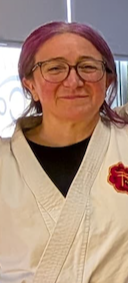
Jen Collins Sensei is an instructor at OKC San Francisco. She started studying Karate in 2012, after Michele Elefante, Shihan, told her to "quit watching and get on the floor." Since that moment, Karate has been a constant source of strength, challenge, and inspiration.
She was awarded the rank of Nidan in Shobayashi Shorin-Ryu and Shudokan Karate in 2018. When she is not training, Jen enjoys healing, gardening, volunteering in her community, and spending time with family and friends.
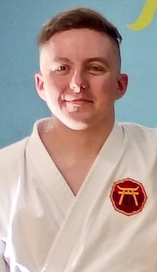
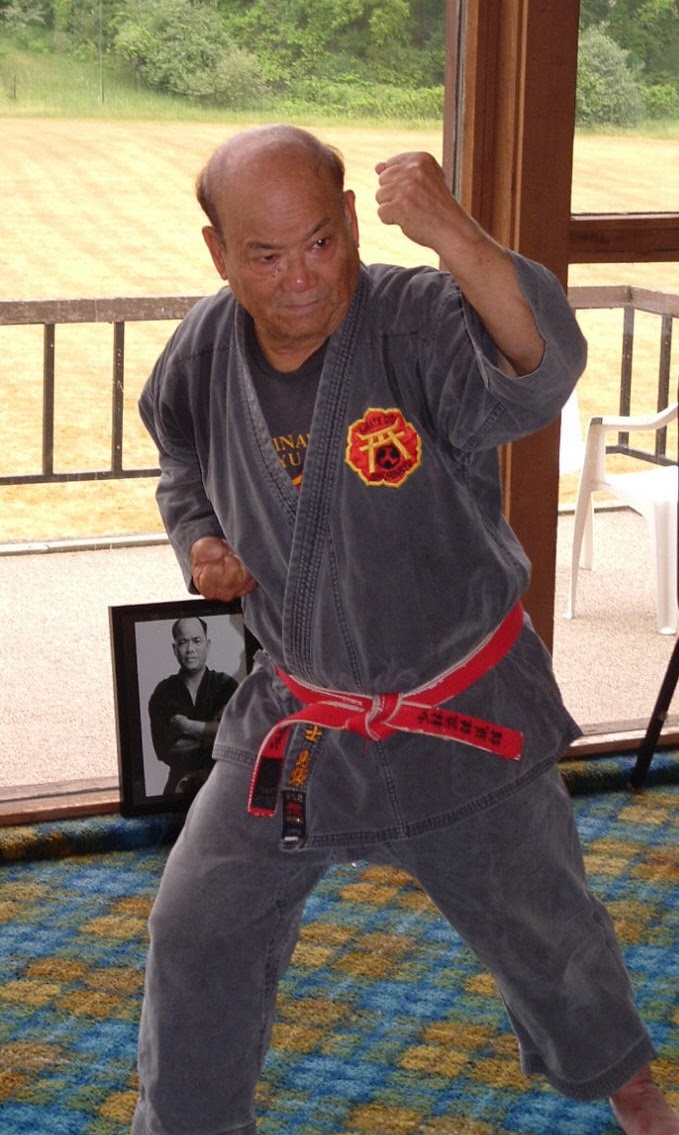
Grandmaster of Shobayashi Shorin-Ryu. Our line descends directly from his teaching.
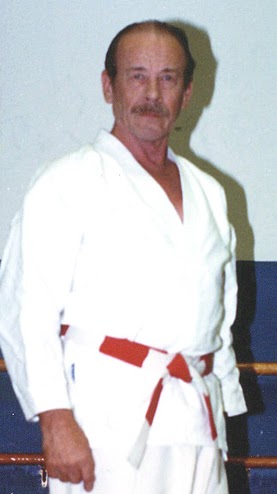
Brought Okinawan Shudokan karate to America — the Shudokan side of our curriculum traces to him.
Ch'an meditation, breathing, and fighting methods that became Shaolin Temple Boxing.
Chinese official who spread chuan fa, the "fist way," across Okinawa.
Blended chuan fa and tode into karate-do, the "Chinese hand way."
A foundational master of the Shuri-te line.
Brought karate into Okinawa's schools; created the Pinan kata.
Master whose teaching shaped Shobayashi Shorin Ryu.
Kyan's top student. Youngest to receive 10th dan. Head of the system until 2017.
Carried Shorin Ryu and Shudokan karate from Okinawa to America.
Passed the system to the Okinawan Karate Clubs.
Primary instructor of Michele Elefante Sensei.
This dojo — where the line continues today.
Karate-do originated in China during the 5th century A.D. with an Indian man's visit to the Shaolin Monastery. The visitor, known as Bodhidharma in Chinese, or Daruma in Japanese, taught the Shaolin monks a combination of ch'an meditation, Zen in Japanese, breathing, and fighting techniques. This fighting system was further developed by the monks and called Shaolin Temple Boxing. A clear connection between this ancient form and our own style, Shobayashi Shorin Ryu, is revealed through a simple linguistic analysis. Shaolin and Shorin are phonetic interpretations of the characters that mean "small forest." The Japanese pronunciation for the same characters is sho bayashi. Thus, Shorin Ryu karate is directly related to Shaolin Temple Boxing.
It took a long time, however, for this practice to expand from its place of origin. The Chinese first demonstrated their martial art in Okinawa during the 14th century, when the two countries were involved in heavy trade, but it was not until the 18th century that the art really began to spread. It was at this time that Kusanku, the Chinese military official, came to Okinawa. He allegedly gave a demonstration in 1761, which included punching, jumping, kicking, and blocking techniques and subsequently began teaching chuan fa, fist way, during his visits to Okinawa. Kusanku therefore played a major role in the expansion of this martial art.
Other important figures in the evolution of karatedo are Peichin Takahara and Tode Sakugawa. An Okinawan renowned in the indigenous art of tode, Monk Takahara was the first to explain the meaning of the word "do" as it applied to karate. He cited three aspects of do: igo, the way or spiritual aspect; ho, the self-defense application; and katsu, the life-giving or practice and understanding of the physical techniques. Tode Sakugawa, who had studied with both Takahara and Kusanku, combined the teachings of the two instructors to form a blend of chuan fa and tode called karatedo, Chinese hand way. The name of our system has thus evolved.
Some of the more prominent students of Bushi Matsumura include Yasutsune "Anko" Itosu, 1830-1915, Chotoku Kyan, 1870-1944, and Choki Motobu, 1871-1944. Itosu, known for his great strength and agility, introduced karatedo into the public school system, where he broke down the complicated Kusanku kata into five shorter forms called Pinan.
Itosu's contemporary, Kanryo Higashionna, 1845-1915, influenced Shorin Ryu in yet another way. After spending twenty years in China, Higashionna returned to Okinawa and began teaching a soft or internal style called Naha-te. Named Goju, hard-soft, Ryu by Higashionna's student Chojun Miyagi, this system became the other primary influence of Okinawan karate styles. Two of the Goju kata, Sanchin and Seiunchin, have been incorporated into Shobayashi Shorin Ryu by Shimabukuro Eizo O'Sensei, 1925-2017.
Although Shimabukuro O'Sensei studied under Miyagi before taking up Shorin Ryu, it was Chotoku Kyan who had the greatest impact upon him. Perhaps the clearest evidence of Kyan's immeasurable skill is exemplified by our own grand master Shimabukuro Eizo O'Sensei. As Kyan Sensei's top student, Shimabukuro O'Sensei was left in charge of the Shobayashi Shorin Ryu system at the time of Kyan's death.
As Kyan Sensei's top student, Shimabukuro O'Sensei, born in the village of Gushikawa on April 19, 1925, was left in charge of the Shobayashi Shorin Ryu system at the time of Kyan's death. Having received the tenth dan red belt at the age of thirty-four in 1959, Shimabukuro O'Sensei holds the distinction of being the youngest person to ever achieve such an honor. His 10th dan was awarded by Kanken Toyama Sensei and his certificate is No. 25. Toyama Sensei also made him the Chairman of the Okinawan branch of the All Japan Karatedo League. Shimabukuro O'Sensei was the head of the Okinawan Shorin Ryu Karatedo International Association League until his passing in October 2017. O'Sensei was also honored with a Judan, 10th Dan, certificate from the Rengokai Association on Okinawa. There are only five people on Okinawa, including O'Sensei, who hold that rank.
Shimabukuro O'Sensei studied Kobujutsu, ancient weaponry, under Shinken Taira and incorporated it into our karate system. In May of 1948, Shimabukuro O'Sensei opened his first dojo. This was the beginning of what came to be over 50 years of continuously teaching traditional karate. For 20 years the U.S. Marine Corps contracted Shimabukuro O'Sensei to teach their troops at several different dojos. Grand Master Shimabukuro estimated he had personally trained as many as 35,000 troops including Army and Air Force.
For all he contributed to karatedo, he continued to aid in its growth and development by sharing his knowledge with other followers of the art. Eizo Shimabukuro O'Sensei taught hundreds of students, recording each one's name in a book that he took on all of his tours. Thus, our history is recorded and the spirit of karate-do lives on.
Kyoshi Herbert Wong began studying with O'Sensei in the early 60's. At that time, he had already earned his Nidan from Sensei Walter Todd in Kanken Toyama's Shudokan Karate-Do and had been competing nationally and internationally, along with substantial backgrounds in kung fu, judo, and aikido. Kanken Toyama had written a letter of introduction to Choshin Chibana for Kyoshi Wong to study with him in Okinawa. Because of the slowness of international mail by boat at the time, he had personally selected O'Sensei Shimabukuro's Moromi Headquarters Dojo instead based upon his observation of the way he taught and the quality of students practicing with him.
O'Sensei had many famous students that he trained. The famous Joe Lewis trained with O'Sensei in 1964-65. Sensei Herbert Wong was there when Mr. Lewis first signed up with O'Sensei, and he was on the board of examiners along with O'Sensei when Mr. Lewis tested for his green belt in 1964.
Prior to Wong Sensei leaving Okinawa in 1965, O'Sensei had asked that he help systematize his training system and help him write a book about Okinawan Shorin-Ryu Karate-Do. Wong Sensei is primarily responsible for much of the way we teach O'Sensei's curriculum today that has been handed down to us through Hu Sensei, Scott Sensei, and Christensen Sensei.
Many of the major dojos connected to O'Sensei today are part of Wong Sensei's lineage, including the San Francisco Dojo under Andrew L. Chan, 6th Dan, Shihan, and the Ann Arbor Dojo currently under Karl W. Scott, III, 5th Dan, Renshi, and formerly under Gary Hu, 5th Dan, Renshi, where Sensei Barbara Christensen and Sensei Ilene Smoger began their Shorin Ryu and Shudokan training.
Walter E. Todd Shibucho (1927–1999) was a historic American martial arts pioneer and the official U.S. Branch Director for Shudokan Karate. He holds a legendary place in martial arts history as one of the very first Westerners to deeply embed himself in post-WWII Japan, eventually earning high ranks in Judo, Aikido, and multiple styles of Karate under the country's founding grandmasters. Stationed in Tokyo with the American military in 1945, Todd married and lived in Japan off-and-on over three decades.
Upon returning to the United States, Todd continued his karate training under Yoko Takahashi, a top disciple of Kanken Toyama, the founder of Shudokan Karate. Impressed by his immense dedication and skill, Toyama appointed Walter Todd as the official Shibu-cho (Branch Director) for the United States. He was issued certificate No. 26, granting him total authority to rank students and oversee the development of Shudokan Karate across America. Following Kanken Toyama’s passing, Toyama's son officially approved Todd's rank of 8th Dan in Shudokan.
Todd Sensei was Dr. Herbert Wong Sensei’s first karate instructor. Gary Hu Sensei and Karl Scott III Sensei were introduced to Todd Sensei and the martial arts he taught through Wong Sensei. It was through Hu and Scott Sensei that Christensen Sensei and Smoger Sensei were introduced to Todd Sensei. Over the years, Todd Sensei directly trained Smoger Sensei and frequently visited OKCD where katas from Shudokan were passed down.
Gary Hu Sensei was a student of Isao Ichikawa Sensei, the founder of Doshinkan Karate-do. Smoger Sensei also learned several kata through Gary Hu Sensei.
Todd Sensei was an accomplished martial artist. He trained directly at the Kodokan Judo Institute under Kyuzo Mifune (10th Dan) and Ichiro Abe (8th Dan). Mifune, the last living master to receive his 10th Dan directly from Judo founder Kano Jigoro, accepted Todd as a personal student. Todd eventually achieved an 8th Dan in Judo. In 1948, Todd became the first foreign student of Hironori Otsuka, the founder of Wado-Ryu. Shotokan Karate: In 1954, he trained under Isao Obata, a direct student of Gichin Funakoshi (the "Father of Japanese Karate"). Funakoshi himself approved Todd’s Shodan certificate, making Todd the first foreigner in history to obtain a black belt rank in Shotokan. To fully round out his martial arts prowess, Todd also mastered Aikido. He trained closely under Kenji Tomiki (founder of Tomiki/Shodokan Aikido) and Koichi Tohei. Todd Sensei first and second Dan certificates were personally signed and approved by Ueshiba Sensei. He would later receive the rank of sixth Dan from the Kokusai Budoin making him one of the highest ranking non-Japanese Aikido instructors in the world.
Todd Sensei believed that balance was the most important quality in martial arts; “Without balance, you cannot have a strong stance, and without a strong stance as a foundation, you cannot throw effective kicks or punches. Balance is the most important thing for any marital artist.”
Gary Hu Sensei and Karl Scott III Sensei of Ann Arbor, Michigan, were introduced to Shorin Ryu karatedo through Herbert Wong Sensei, a 7th dan under Shimabukuro O'Sensei. Hu Sensei, Scott Sensei, and Barbara Christensen Sensei have been primarily responsible for passing down Shorin Ryu karatedo to Smoger Sensei and our Club.
Barbara Christensen, a 6th dan under Shimabukuro O'Sensei and the director of training of the Okinawan Karate Club of Ann Arbor, is Smoger Sensei's primary instructor. Ilene Smoger, currently the Director of Training at the Okinawan Karate Club of Dallas, is Elefante Sensei's primary instructor.
From the dojo
A practical training culture: partner drills, weapons practice, group classes, and study outdoors — moments from the dojo over the years.
Try a class · 体験
Send a message and we'll get back to you — no experience needed. Saturday is usually the best class for a first visit.
Okinawan Karate Club of San Francisco
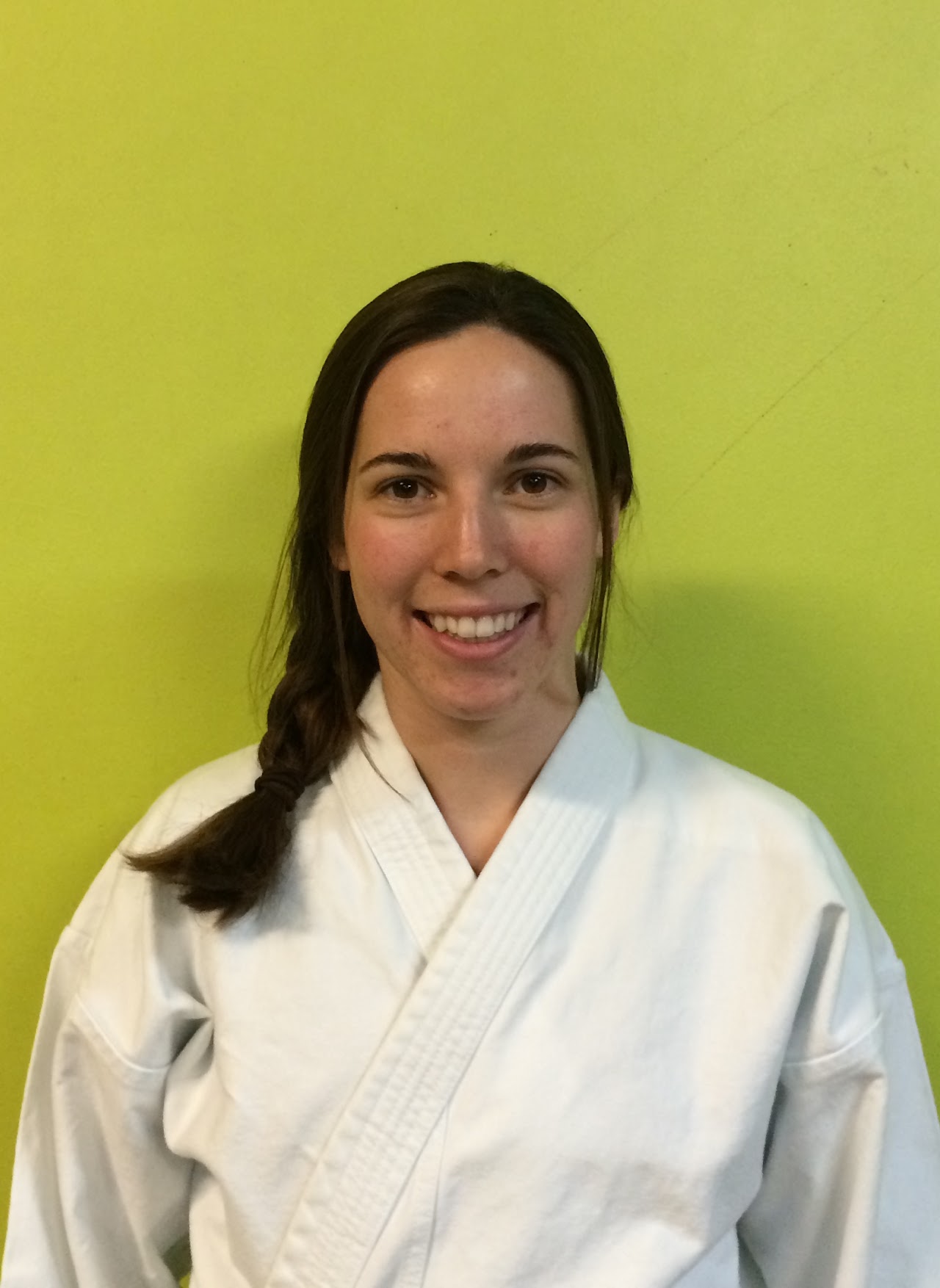
Emily Kemp Sensei, instructor at OKC San Francisco, began studying Okinawan karate under Sensei Dennis Branchaud in 1999. She was awarded the rank of Shodan in Ryukyu Hon Kenpo Kobujutsu in 2009 and continues to train at the Kodokai Dojo in karate and Udundi whenever she is back in Rhode Island.
Emily has been training with Michele Elefante, Shihan, and Sensei Deb Lee at the Okinawan Karate Club of San Francisco since 2015. She was awarded the rank of Nidan in Shobayashi Shorin-Ryu and Shudokan Karate in 2018. She holds a degree in Economics from William Smith College and enjoys skiing, cycling, rock climbing, and sailing when she is not at the dojo.
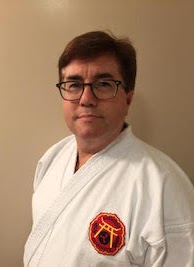
Ken Lerseth Sensei was an instructor at OKC San Francisco. A martial arts student since 1981, Ken practiced Goju Ryu from Budokan in Sacramento. He began training with Michele Elefante, Shihan, and Sensei Lee at Okinawan Karate Club San Francisco in 2008.
Ken held a degree in Business Administration and Finance and was a consultant for major brokerage and investment management firms.